
Fable 5 and the Friday Night Shutdown
The Fable 5 and Mythos 5 shutdown maps the borders of frontier AI.

Once Upon a Time
This is the story of a 21st-century fable, one that is still unfolding.
Fables often feature animals as the main characters. Frogs, foxes, crows, cranes, storks. They are vessels for passing down lessons, warnings, and codes of moral conduct. Fables teach universal truths through stories.
This fable involves Anthropic’s Mythos-adjacent Fable 5, rolled out to general users on June 9. According to Anthropic:
Fable 5’s capabilities exceed those of any model we’ve ever made generally available. It is state-of-the-art on nearly all tested benchmarks of AI capability, showing exceptional performance in software engineering, knowledge work, vision, scientific research, and many other areas.
It was a Saturday morning like any other. I was sipping fresh-brewed coffee and had just played a round of Wordle. Then I absentmindedly checked my email. And there it was, a message from the Claude team: “Claude Fable 5 access suspended.” I did a double-take. I can’t recall ever receiving an email like that from a digital service provider. Claude Fable 5 access suspended? A directive? Needless to say, this got my attention.
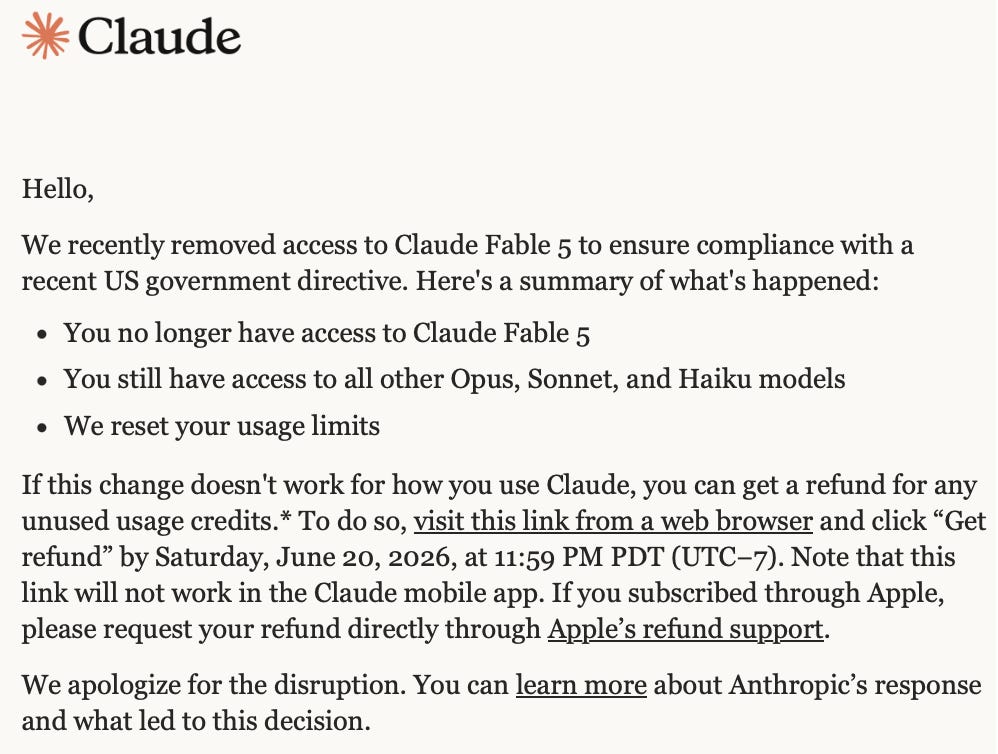
I then learned that the U.S. Commerce Department placed an export control directive to deny access to Fable 5 and Mythos 5 by any foreign national, whether inside or outside the United States, including foreign-national Anthropic employees. Because Anthropic apparently could not isolate access that way, the company said it had to abruptly disable both models to ensure compliance. Anthropic understood the concern to be that officials had become aware of a way to bypass, or “jailbreak,” Fable 5’s guardrails. Anthropic said it had reviewed a demonstration involving a small number of previously known, minor vulnerabilities.
There were also various (as far as I know) unconfirmed reports about Anthropic CEO Dario Amodei’s availability during this Friday night scramble, including claims that he was attending a wellness retreat, a claim which Anthropic reportedly rejected. That detail would be perfect for a brand new season of HBO’s Silicon Valley — and that’s, frankly, the only reason I’m mentioning it here. The comic level narrative absurdity in the face of such high stakes, involving world economies, open access, cybersecurity, and public safety is, as they say in Hollywood, one for the screenplay.
As of this writing, the Fable 5 story is still evolving, and the hot takes are flying in every direction. As for myself, I was just getting started using Fable 5 and was disappointed to have lost access.
Early Signs of Concern
Before the export control was enacted, Amazon had entered the fray to weigh in with its concerns over Fable 5. Amazon happens to be a major Anthropic investor. According to CNBC, “Amazon has agreed to invest up to $25 billion in Anthropic, on top of the $8 billion that it has poured into the artificial intelligence startup in recent years. Anthropic has also pledged to invest $100 billion in the AWS infrastructure.”
According to Axios, Amazon called administration officials with a report showing how researchers had jailbroken and accessed portions of Anthropic’s powerful Mythos model — and that this raised national-security concerns.
Microsoft also restricted its own employees from using Fable 5 within days of release, citing data retention terms incompatible with its internal policies. Microsoft had committed $5 billion in equity investment in Anthropic. It’s also notable because generally Claude is the preferred platform for engineers and programmers so this move by Microsoft bears more attention, especially considering the emphasis on using GenAI to speed up traditional coding and engineering.
Officials Weigh In
Eight months before the shutdown, David Sacks, the White House AI and Crypto Czar, stated that Anthropic’s safety rhetoric risked shaping regulation in ways that would favor incumbents and constrain the broader innovation ecosystem.
Then, on June 13, 2026, Sacks posted a more detailed account on X of what led to the Fable 5 shutdown. This account points out that a “highly credible trusted partner” of both Anthropic and the U.S. government (Amazon?) discovered a jailbreak of Fable’s guardrails.

Anthropic was asked to fix the vulnerability or pull the model. Anthropic purportedly refused. Anthropic apparently took the stance that the issues were narrow and reproducible on other models. The export control move was presented as a last resort. Sacks concluded that the “hope now is that Anthropic remediates the safety issue, the export control is lifted, and Fable goes back into general release.”
So much software is built by multinational teams, running on cloud infrastructure, accessed through APIs, and improved through distributed software workflows, so it makes sense from this understanding that Fable 5 had to be pulled globally to be in compliance with this new mandate.
A Self-Fulfilling Prophecy?
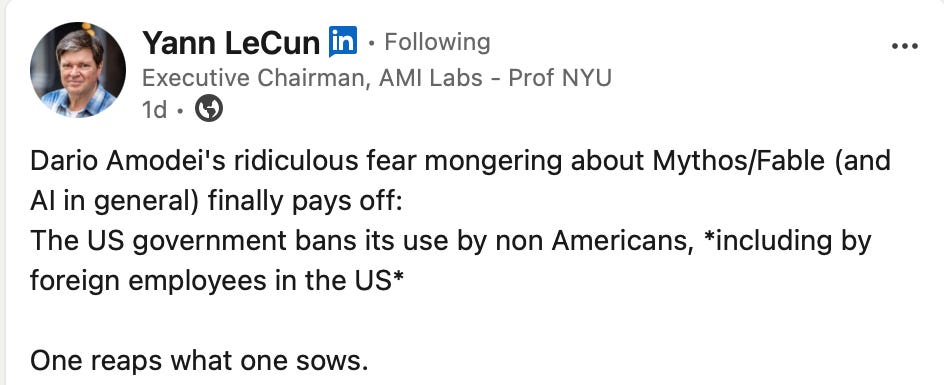
Some criticism has also fallen on Dario Amodei. Amodei spent years warning that frontier AI could become dangerous, advocated for expanded government oversight. Yann LeCun said it plainly on LinkedIn: “One reaps what one sows.”
Fable 5 was presented as more than just an ordinary chatbot. Anthropic's own launch materials described it as the most capable model the company had ever made generally available. The benchmark table told its own story: agentic coding, cybersecurity, biology, health, legal reasoning, tool use, spatial reasoning, knowledge work. Whether or not every benchmark translates neatly to real-world use, the positioning was unmistakable. This was fast approaching a general-purpose intelligence platform.
Anthropic also made clear that Fable and Mythos were closely related. For most sessions, Anthropic said Fable would behave essentially like Mythos. But when certain cyber, biology, chemistry, or distillation-related requests were detected, the system could fall back to Claude Opus 4.8 or otherwise limit what it would do.
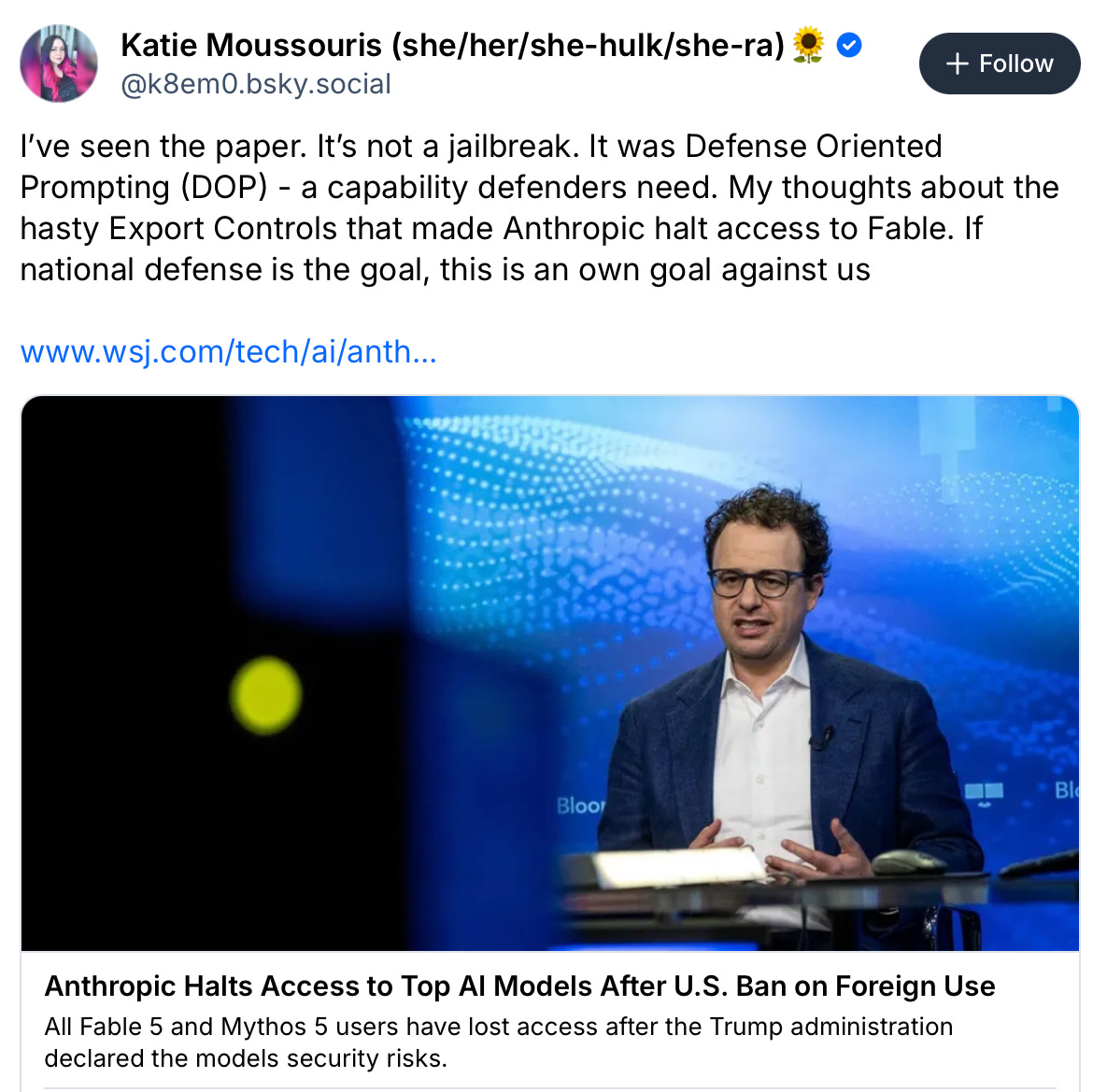
The word “jailbreak” sounds dramatic to many, suggesting something that is breaking out of its cage, suddenly freed from constraints. From what has been reported so far, the demonstration seems to have involved prompting the model to provide information about a handful of security vulnerabilities. Katie Moussouris of Luta Security, who reportedly reviewed the Amazon report after Anthropic shared it with her, questioned the jailbreak assignation:
‘All AI models need to be able to help defenders in exactly this way, or we won’t be able to scale our defense against attackers,’ Moussouris said. However, perhaps Fable represented Mythos-level power moving into global circulation before national security concerns were taken into account.
For decades, the digital divide has meant unequal access to devices, broadband, software, opportunities, information, and services. Frontier AI adds a new layer around access, capabilities, and perhaps regional borders. Who is guaranteed access to the most capable, least restricted systems? The divide may be between those allowed to use general-purpose frontier systems and those given narrower, pre-approved versions.
In the 1990s, encryption software was regulated as a national security concern. The encryption battles of the early 1990s centered on two major fights: government limits on exporting encryption technologies and the NSA’s push to build a government-access mechanism into communications technology through something called the Clipper chip. The race over AI is even more high stakes and greater regulatory collaboration is needed.
King Log
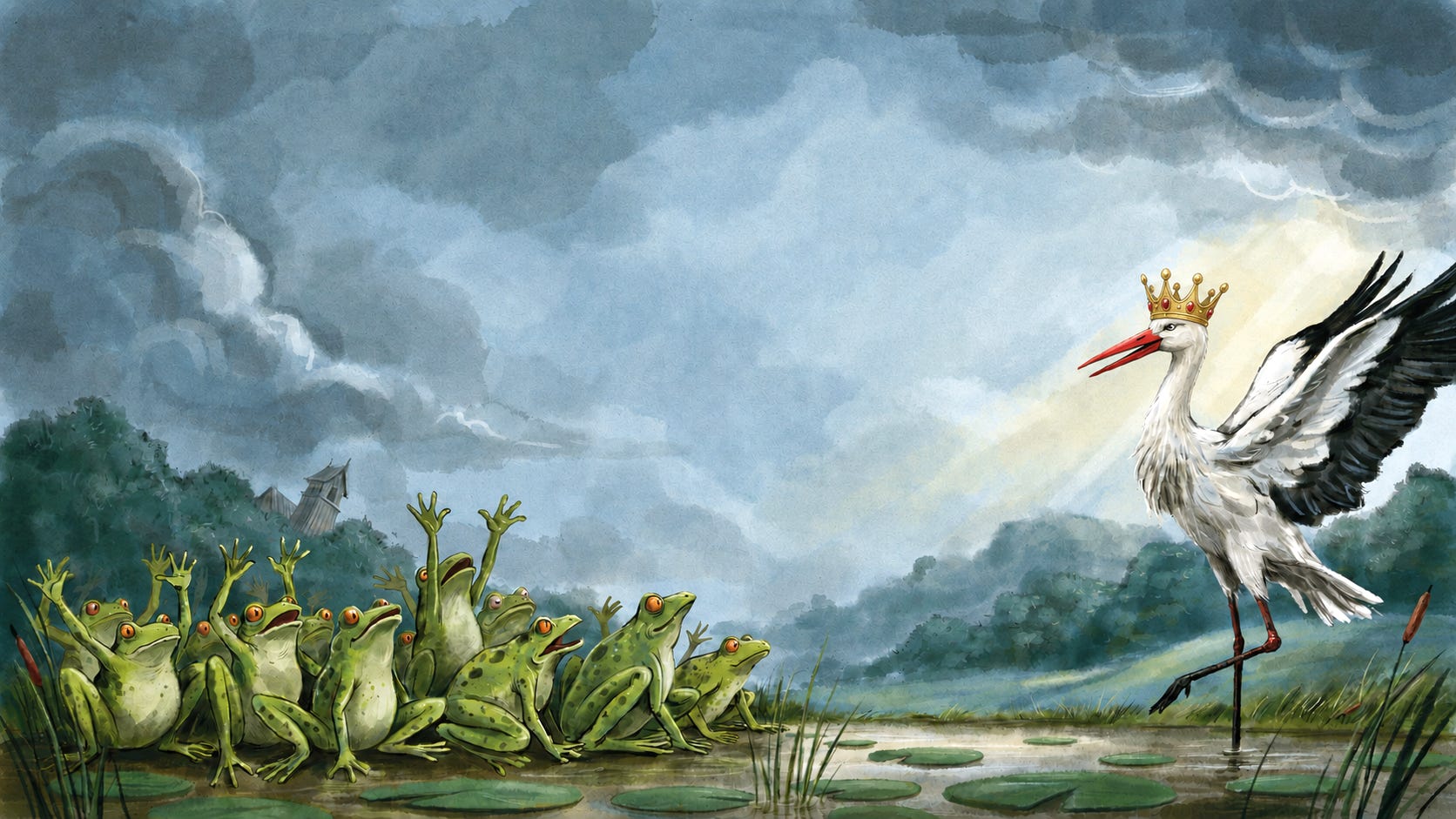
In Aesop’s “The Frogs Who Wished for a King,” the frogs of the pond grow tired of governing themselves and appealed to the god Zeus to send them a ruler. Zeus responds by sending a log down to them. At first, the frogs are terrified when it lands in the pond. Eventually, they climb on it. They discover that their King Log is harmless and docile. They conclude the King Log is useless. So they ask Zeus for a real king.
Zeus sends a stork. The new Stork King commences to eat the frogs, one by one. The frogs were depicted as foolish for offloading personal autonomy onto external figures and not understanding the nature of their desires.
Anthropic itself has made versions of that call to action — arguing for stronger public oversight, mandatory testing, and even the possibility of pausing frontier development under certain conditions. Is it the log or the stork entering the pond — or something else?
The Moral of the Story
The Fable shutdown showed that the off switch works, even if it’s a temporary move until the cited vulnerabilities are remedied. Then what?
It cannot be that frontier AI should remain ungoverned. These systems are becoming part of the operating layer of knowledge in numerous domains. Some of their capabilities are genuinely risky. Some access restrictions may be legitimate. Some forms of public oversight are long overdue.
For companies integrating with these frontier models, the lesson is clear and it is one I emphasize to anyone building products where there’s a reliance on a given technology or platform: deploy as if your chosen model can literally disappear overnight. Because it apparently can and that can have disastrous ramifications for companies.
As these AI models are increasingly integrated into core infrastructures, redundancies must be in place in order to mitigate risk. Multi-model systems, open-source alternatives, and local models may become crucial forms of risk management as frontier AI policies and practices continue to develop.
Ultimately, the lesson of the Fable 5 shutdown is that we probably need an “off” switch for powerful AI, but we cannot offload our collective responsibility for deciding who gets to flip it, under what conditions, and with what accountability. In Aesop’s story, the frogs did not just want a king. They wanted to stop being responsible for the pond. That instinct is understandable. It is also how the frogs ended up being eaten.
The work now is to insist on real participation in shaping these powerful systems while we still can.