DramaBox and the Mobile Game Logic of Modern Microdramas
DramaBox was once the most downloaded video streaming app in the world, beating Netflix and Disney+.


Many people in media circles haven’t heard of DramaBox and yet in 2025, it was the most downloaded video streaming app on the planet — ahead of Netflix, Amazon Prime Video, and Disney+.
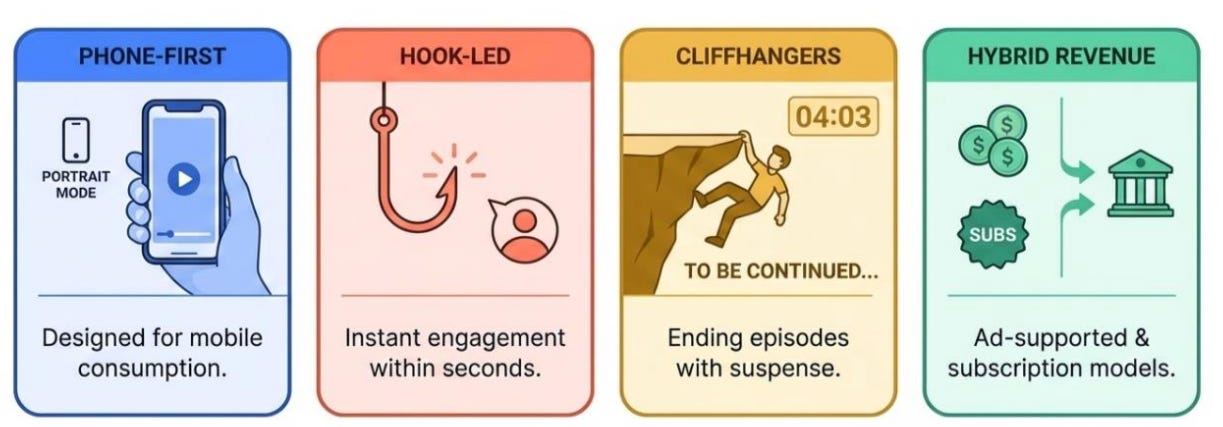
DramaBox is owned by StoryMatrix, a Singapore-based subsidiary of Beijing-based Dianzhong Technology. Disney is also a small early-stage investor. DramaBox is part of a fast-growing platform content category, called vertical microdramas: short, serialized stories designed to be watched on your phone, in portrait mode, in the gaps of a day. The company operates more like a mobile app business than a linear content streaming company, treating serialized fiction like a product to be A/B tested, localized, and optimized.
DramaBox reported $323 million in revenue in 2024. The broader short drama category is projected to reach $25 billion by 2030. In Q4 2025, microdrama downloads overtook traditional OTT streaming downloads for the first time.
I’ve been thinking a lot about how storytelling and technology are converging in ways that are ongoing and sometimes difficult to pinpoint — especially how they inform our understanding of the rapid changes happening around us every day. Yuval Noah Harari, in Nexus, argues that storytelling has always been the connective tissue of human cooperation — the mechanism by which we coordinate behavior at scale, across distances, among people who will never meet. “In order to cooperate,” he writes, “Sapiens no longer had to know each other personally; they just had to know the same story.”
Much of what I write about in this newsletter is the question of who designs the layers of experience we move through — and what values and assumptions get encoded in the process. Usually I’m thinking about physical space, or the spatial intelligence systems moving into the built environment around us. But the same question applies to the attention layer: the immersive media environments we inhabit on our screens, the ones shaping how we spend our time, what stories we encounter, and how we experience them. DramaBox is a useful place to look at that question up close.
Mobile game logic enters the picture
As with so much that happens in the world of media and user experiences, all roads seem to lead back to the video game industry. In the case of microdramas, this is especially true when considering the methods microdrama platforms like DramaBox use to engage and monetize audiences. With the possible exception of casino games, no one has done more than mobile games to understand the design, measurement, and constant optimization of these “compulsion loops” to hold our attention.
Successful mobile games integrate engagement and monetization loops into the design structure of the product from the outset. The pacing of levels, the timing of rewards, the use of scarcity, the introduction of friction, the creation of in-game economies, and built-in customization and social features are all shaped by the underlying monetization mechanisms. DramaBox applies a similar logic to serialized short-form linear content. While episodic content is clearly nothing new, the ubiquity and degree to which these storytelling conventions are now being combined with mobile app economics, behavioral data, and performance marketing is unmatched. Algorithms shape what gets made, what gets amplified, what gets watched, and (ultimately) what monetizes.
In a course I teach on media business entrepreneurship, we use DramaBox as a case study to consider what happens when distribution, narrative, and monetization systems become inseparable. Most media companies still think about these as sequential stages: make the content, then market the content, then figure out how to make money from that specific content. Oftentimes it’s different teams with different vocabularies and timelines.
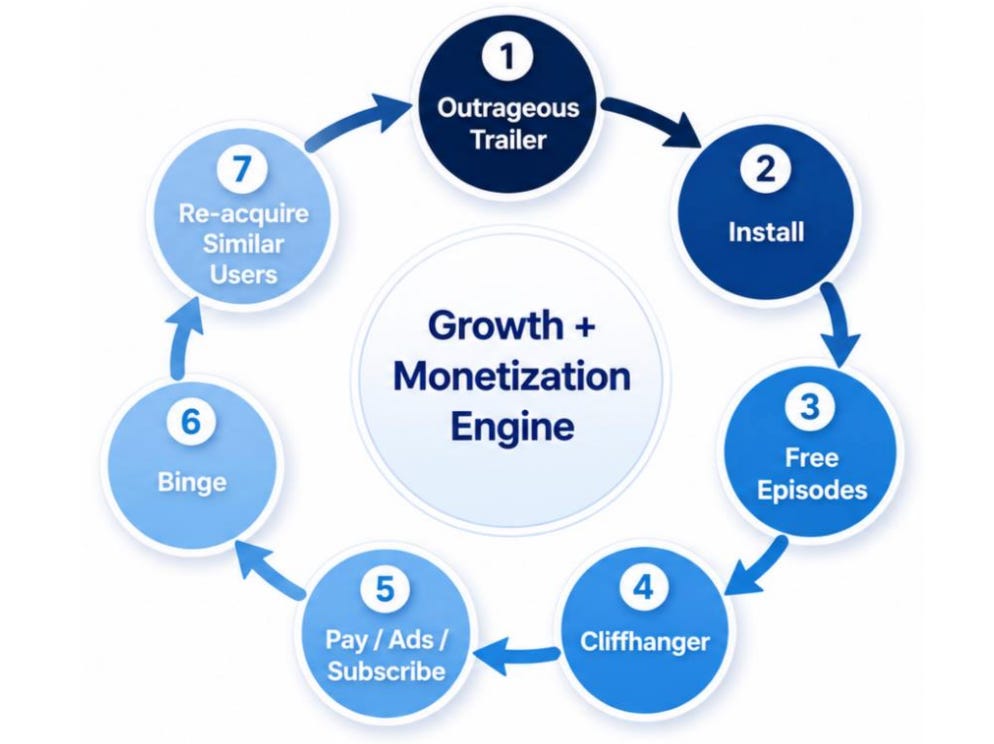
Taking a page out of the best mobile game developers’ playbooks, DramaBox collapsed that sequence entirely, taking a contemporary flywheel approach to media ecosystems and platforms, while emphasizing this vertical format specifically optimized for smartphone usage and environments. The hook in episode one is the same hook in the ad creative running on TikTok or YouTube Shorts. The cliffhanger that ends each episode is also the architecture of the payment moment. The trope on the thumbnail is the same fantasy that drives a coin purchase forty episodes in.
This content repurposing and promotion are built from the outset into the premise, the title, the thumbnail, the opening conflict, the episode ending, and the moment users are asked to pay. This approach is efficient, works for our current platform media environments, and is less expensive to produce.
Microdramas as modern-day soap operas

The microdrama format is engineered around instantly legible storylines — CEO, billionaire, hidden heir, revenge, rebirth, second-chance love — that require almost no cognitive onboarding. They are designed to enable audiences to understand the world within seconds. Every episode is built as a miniature suspense machine: setup, escalation, reveal, cut. The ending isn’t designed to provide closure. It’s designed to make closure feel unbearable to defer.
Short-form content platforms like DramaBox are part of a continuous narrative legacy occupied by soap operas and telenovelas. The DramaBox catalog, true to those roots, is full of billionaire romances, secret heirs, revenge arcs, and women rising from humiliation to triumph. Some popular series on DramaBox include epic tomes such as “Fake Dating My Rich Nemesis” or “Watch Out, I’m the Lady Boss.” The stories are often described as formulaic, some might say absurd — and to many, that’s being charitable.
Think of microdramas as a two-hour movie, cut into sixty to ninety-second clips that tell a continuous story. Every micro episode, at least as of this writing, is designed to end on a cliffhanger, though my industry friends working in this space say there are attempts to change reliance on cliffhangers to retain audiences. The cliffhanger is part of a broader system designed to encourage habituation around engagement.
Early soap operas of the 1930s also have much in common with today’s microdramas in that they often clocked in at 15 minutes per episode vs. the thirty-minute and hour-long dramas most often associated with soap operas at their pop culture prominence, such as “General Hospital” or “The Guiding Light.”
The monetization follows a progression logic perfected by the mobile games industry. Ads you watch to unlock episodes. Coins you buy for incremental access. Subscriptions for heavy users. The compulsion loop is powered by the desire to unlock more narrative. Taking a page out of interactive story games, as AI tools, algorithms, and platforms evolve — it stands to reason that microdramas will eventually experiment with interactivity, adaptive stories, and characters based on user preferences.
What microdramas are selling, at every moment, is the next moment — all infused by cognitively easy narrative frameworks that tap into tropes steeped in sensationalism and melodrama, not too unlike soap operas of the past. It’s hard to argue these storylines are edifying. Nonetheless, I for one am hopeful regarding how they will evolve, so as an art form and a means to reach new audiences, I’m intrigued. As a form of persuasive media leaning heavily into these embedded engagement loops, we must pay closer attention.
Future implications
I’ve written before about how physical spaces encode meaning before a single word is spoken — how museums, monuments, and maps tell us what’s valued, what belongs, and which story gets told. Algorithmic media environments, including DramaBox, work similarly, just faster and at a broader scale. In our digital spaces, we are awash in information, in content, in stories. The mechanisms that surface and shape these stories are increasingly algorithmic, personalized, measured, and adaptive. They surface some stories and suppress many others. These platforms reward certain emotional registers and “punish” subtlety. They shape what is presented as normal, what feels aspirational, and what fuels possibilities.
The next wave of microdramas is already underway. Given signals from Netflix, Tubi, and Amazon as they wade into the vertical content streams, it’s worth taking a hands-on approach to steer where this form of storytelling can take us before the space becomes too crowded. If I’ve learned anything from the mobile games industry, the time is now to push for more kinds of stories, storytelling, and user experiences. As the category scales, audiences and creators may demand better acting, more varied plots, and less formulaic storytelling. As creators, it’s time to seize the moment before the space becomes too entrenched in these platforms, and narrowed by algorithms.
GenAI use note: I used generative AI tools to help develop visual concepts for images and to support editing and refinement of this essay. The analysis, argument, and final editorial decisions are my own.